


The high frequency of industrial accidents has recently attracted the attention of the public and government to the quality of products and personnel safety issues. Because the causes of accidents are widely diverse, different preventative technical measures need to be applied. However, it is important that functional safety testing undergoes constant improvement to assure the quality and safety of products and avoid the occurrence of unexpected accidents.
On 18-19 October, 2011, the TüV Rheinland International Functional Safety Symposium – Functional Safety in Industrial Applications – was held in Shanghai. This was the first ever TüV Rheinland event on functional safety to take place in China. On the occasion of this symposium, Mr Heinz Gall, Executive Vice President, Functional Safety, TüV Rheinland accepted an interview with IIANews and expressed his views on the development of functional safety.
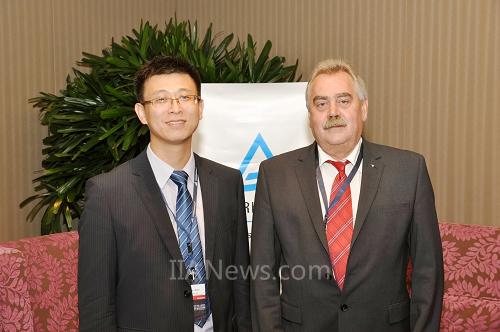 nload="javascript:if(>500)=500" align=center border=0>
Mr. Zhao Bin and Mr. Heinz Gall (right)
How can we achieve Functional Safety?
Considerable attention is devoted worldwide to the design of process safety control systems and industrial equipment safety control systems, which are fundamental to public and occupational safety. Safety-related electrical, electronic and programmable electronic systems have been developed into a mature safety design technology – functional safety technology. The definition of functional safety states that it will not induce faults in safety systems; whatever random faults, systematic faults or common cause faults occur in individual components or the whole system, it will not result in any hazard to personnel or to the environment. only with such a definition can we state that a system is functioning safely.
Complex electrical, electronic and programmable electronic components are increasingly used in safety control systems, and any faults in such a system may have serious consequences for personnel, equipment, the public or the environment. To ensure the functional safety of such a system, the international standard IEC61508 has been set up as a fundamental framework. Mr. Heinz Gall has been working closely with the German standard committee of the IEC61508 and IEC61511 working group in generating and formulating the relative international standards from 1985. “IEC61508 is the basic international standard of functional safety. IEC61508 has defined the so-called safety life cycle phases for products and systems, starting with the safety specification for overall design and development, through to verification and validation, installation and operation. IEC61508 specifies techniques and measures to avoid faults in the design and development phases”, Mr. Heinz Gall said. Europe and America have released relative application standards for different industry sectors. Europe, for example, established EN 50128, IEC61513, EC62061, ISO13849 and IEC61511 for railway, nuclear, machinery and process, respectively.
Several years ago, IEC61508 and IEC61511 were translated and published in China. The China Commission for Conformity Certification of Electrical Equipment also cooperates with the International Electro Technical Commission, and there is also a working group for IEC61508 and IEC61511.
Why is TüV Rheinland the best service provider of Functional Safety consulting and training?
As global buyers increasingly demand the functional safety of products, the certification of products has become increasingly important for equipment purchasing decisions. Among the many certification authorities, why do customers select TüV Rheinland? Mr. Heinz Gall explained TüV Rheinland’s significant advantages compared to other organizations.
First, TüV Rheinland has a long history and rich experience in functional safety. Forty years ago, TüV Rheinland started research work on functional safety and supported companies to develop safety related control products. At the same time, they also took part in the development and modification of functional safety standards. Second, TüV Rheinland’s powerful worldwide service network allows them to respond rapidly to customers’ requirements, with a team of more than 50 functional safety engineers and experts located in Germany, China, Japan and the US. In the past 10 years, the Functional Safety business division of TüV Rheinland has certified more than 500 safety related products and has certified more than 30 functional safety management systems. Since the end of 2004, over 4,000 engineers have taken part in TüV Rheinland’s Functional Safety Engineer training and obtained a TüV Functional Safety Engineer certificate. “We can see that 70% of safety PLCs in the world are certified by TüV Rheinland”, Mr. Heinz Gall commented. All of these competences and advantages contribute to why companies choose TüV Rheinland.
The TüV Rheinland Group has more than 500 branches in 61 countries across five continents, with over 14,500 employees around the world. There are branches in nine cities in China at present, providing local testing and certification services for product safety and quality management system. Third, TüV Rheinland services are involved in as many as 39 fields, such as industry and power, transportation services, machinery, electrical and electronics, non-electronics and so on, providing more than 2,500 added-value services.
Promoting Functional Safety - Are You Ready?
As one of the leading groups for testing and certification in the world, TüV Rheinland has operated in China since 1986, supporting China’s companies to develop and manufacture products that meet specific technical requirements to exploit the global market.
TüV Rheinland provides functional safety certification for safety-related products starting from the concept inspection of the product to be tested, to the main inspection and finally leading to certification if all of the requirements are fulfilled. Functional Safety Management systems are also certified, which means that the procedures and accreditation of companies that manufacture safety-related products or systems covering different life cycle phases, from concept to design and development, are applied appropriately. Through analysis and verification, it has to be ensured that products and documentation comply with the international relevant standards IEC 61508 and IEC 61511. TüV Rheinland also provides consulting services to system integrators and end-users, informing them of how to integrate functional safety products into their safety instrument systems and safety applications. Due to the complexity of the IEC 61508 and IEC 61511 standards and other related standards, and differences in their national and international application, TüV Rheinland also provides training and workshops to engineers working as product developers and designers, or as system integrators with an end-user.
According to Mr. Heinz Gall, there is a serious shortage of highly qualified personnel in industry functional safety. However, the current lack of university courses on functional safety means that the only option for engineers wishing to increase their knowledge of functional safety is to be trained by professional organizations such as TüV Rheinland to achieve industry functional safety knowledge. TüV Rheinland provides two types of training – regular internal training and TüV certified functional safety engineer training. “In China, we provide a training program for functional safety including training for hardware and software design, based on IEC61508. We also provide application sector training for Safety Instrumented Systems, Machinery Safety and Automotive Systems. Training for functional safety management will be provided next year and we hope to train more qualified people in industrial functional safety”, Mr. Heinz Gall said. At present, there are two training bases in China, located in Shanghai and Beijing. It is possible that TüV Rheinland will cooperate with China’s companies and universities to create further training opportunities.
To promote the development of functional safety worldwide, and especially in China, TüV Rheinland held its 10th Symposium on “Functional Safety in Industrial Applications” in Shanghai, China, for the first time. Around 200 people attended the two-day symposium and accompanying exhibition, including the top experts, technicians and managerial personnel of manufacturers and system integrators from different countries, together with several official members of the Chinese Government. Mr. Heinz Gall pointed out that the promotion of functional safety and related concepts cannot be carried out by an individual organization or enterprise. It depends on the engagement, cooperation and combination of many international manufacturers, integrators and end-users to achieve a positive and sustainable impact on functional safety awareness. “The fact that so many participants from all over the world came together at this Symposium to communicate state-of-the-art technologies and information about functional safety and promote its development signifies the importance of this event”, Mr. Heinz Gall concluded.